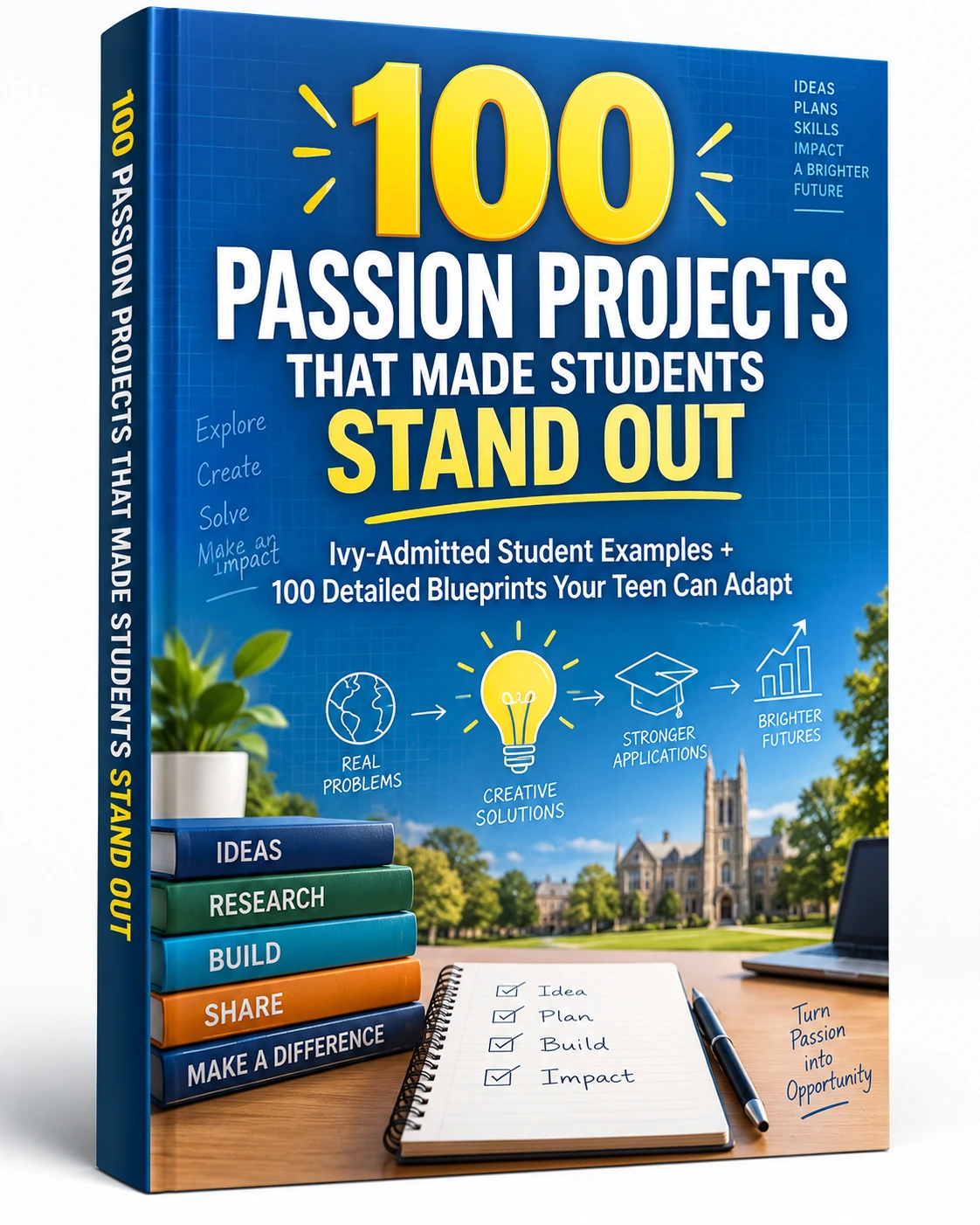
100 Passion Projects That Made Students Stand Out
Ivy-admitted student examples plus 100 detailed blueprints your teen can adapt.
The Problem This Solves
Every fall I hear a version of the same message from parents: "We keep telling our kid to find a passion project. Nobody tells them what to do next."
That's the actual problem. "Find your passion" isn't a plan. It's a sentence that leaves a sixteen-year-old standing still for months while the rest of the application waits on it.
Most of what's out there doesn't help. A list of past projects tells you what other students did, not what yours should do this week. Generic advice tells a robotics kid and a poet the same thing: "be specific," "show initiative," "start early." None of it says what to actually build, what it costs, or who to email first.
What's Inside
- 100 blueprints, each broken into 3 working pages: Fit and Setup, The Build, and Evidence and Translation
- A 16-week, 5-phase build plan for every project with named weekly tasks, not vague milestones
- A real materials and cost breakdown for each project (most run under $150), plus the exact free tools to use
- Browse by major (9 categories) or by project type (16 categories), so your student can filter by what they can actually access
- A pilot target and evidence packet checklist built into every blueprint
- A fill-in-the-blank formula that turns 16 weeks of work into an application line that holds up to a follow-up question
What Most Guides Give You, vs. What This Gives You
| Most guides | This guide |
|---|---|
| "Start a nonprofit" | The real cost, the free tools, and the first email to send this week |
| A list of ideas | 16 weeks of named tasks, phase by phase, so nobody's guessing what "week 7" means |
| The same advice for every student | 100 blueprints sorted by major and by what your student can actually access |
| "Track your progress" | A pilot target and a specific evidence packet built into every blueprint |
| A blank page when it's time to write the essay | A fill-in-the-blank formula tested against the actual application character limits |
Every Blueprint Has 3 Working Pages
Fit and Setup
Who this project actually fits, and who should skip it. Prerequisites stated plainly. A real materials and cost breakdown, most run under $150. The exact free tools and platforms to use. Who to recruit, where to find them, and a script your student can send this week.
The Build
Sixteen weeks, broken into five phases, with 4 to 6 named tasks per phase. Not "build version 1." The actual task: wire the sensor, run the pilot, log the failures, fix the one that matters most. Every phase ends with a plain statement of what now exists.
Evidence and Translation
The three specific ways students wreck this kind of project, and how to recover from each. A pilot target that defines what "it worked" actually means. An evidence packet checklist. A fill-in-the-blank formula that turns 16 weeks of work into an application line, plus prompts to brief a recommender.
Browse by Major
| Major | Blueprints |
|---|---|
| Computer Science, AI & Data Science | 12 |
| Engineering, Robotics & Physics | 12 |
| Biology, Medicine & Public Health | 11 |
| Psychology, Neuroscience & Mental Health | 10 |
| Economics, Finance & Business | 11 |
| Political Science, Law & Public Policy | 12 |
| Environmental Science & Sustainability | 11 |
| Humanities, Languages & History | 11 |
| Arts, Media & Communication | 10 |
Browse by What It Actually Takes
Every blueprint is also indexed by project type, so a family can filter by cost and by what their student already has, not just by subject. Eleven of the sixteen project types run under $150.
| Project type | Blueprints | Typical cost | Needs first |
|---|---|---|---|
| Independent research and analysis | 15 | Under $40 | Reading and note discipline |
| Recurring service and operations | 13 | $0-60 | Reliability |
| Events, conferences, and convenings | 13 | $0-400 | Email and budget discipline |
| Teaching, curriculum, and cohorts | 11 | $0-120 | Subject knowledge, two years ahead |
| Publishing on a cadence | 7 | $0-80 | Producing on a schedule |
| Campaigns and first-time participation | 7 | $0-150 | In-person recruiting |
| Hardware, devices, and prototypes | 6 | $40-120 | Wiring diagrams and basic code |
| Studio, portfolio, and performance | 5 | $40-250 | Medium skill, tolerance for critique |
| Product, venture, and customer discovery | 5 | $0-200 | Talking to strangers |
| Long-form writing and translation | 4 | Under $50 | Sustained writing, or dual fluency |
| Advocacy, policy, and civic change | 3 | $0-60 | Reading public documents |
| Mentoring and matching programs | 3 | $0-80 | Reliability, safeguarding training |
| Software tools and user pilots | 3 | $0-60 | Ship and deploy something small |
| Archival and primary-source work | 2 | $0-70 | Patience, accurate transcription |
| Supervised placement, scoped contribution | 2 | $0 | Working to someone else's spec |
| Small bounded pilot | 1 | $0-100 | Scope control |
Who Wrote This
I'm Jenny. MIT Class of 2008, Brain and Cognitive Sciences, and I've served as an MIT educational counselor interviewing applicants for over 10 years. Twice a year I sit across from a student and ask them to tell me about the thing they built. I can tell within ninety seconds whether a project was actually built or assembled for the application.
Every one of the 100 blueprints in this guide is grounded in a real, source-labeled applicant profile, not a guess at what might work. I priced the materials, tested the tools, and wrote the specific week-by-week build plan for each one myself.
Who It's For
Students in 9th through 11th grade who haven't started a passion project (or started something vague), and families who want a specific next step instead of another list of ideas.
A good fit if
- Your student is in 9th through 11th grade and hasn’t started, or started something vague
- You want a specific next step, not another list of ideas
- Your student has some access already: a school club, a local organization, a skill, a workspace, and just needs a structure to build inside of
Not the right fit if
- Your student already has a fully built, well-documented project. This guide is for building, not retrofitting a narrative onto finished work.
- You’re looking for a guarantee of admission. No guide can offer that, and any that claims to is lying to you.
Common Questions
Does this guarantee admission?
My student already started something. Is this still useful?
My student doesn't know their major yet.
Is this a replacement for one-on-one consulting?
How is this delivered?
What if I want a refund?
“We'd been spinning our wheels for two years. Jenny's framework finally showed us exactly what our son needed to build. He got into his top-choice school.”
Free Related Reading
Send Jenny what your student is considering and she'll send back specific feedback: what's strong, what's missing, and what to fix before they start the sixteen weeks.
Already in the Inner Circle? It's already included at no extra charge.
428-page PDF/digital download. Instant access after purchase. Works on any device.
Ready to get started?
Your student doesn't need another list of ideas. They need to know what to do this week, and the week after that, for sixteen weeks, until there's something real to show for it.
30-day money-back guarantee · Instant access